Table of Contents
ToggleRejuran Skin Booster and Pico Laser: Addressing Skin Quality Alongside Pigmentation
Quick summary
Pico Laser and Rejuran Skin Booster (DEP) target two distinct skin concerns that frequently appear together: visible pigmentation such as dark spots and uneven tone, and underlying skin quality issues including dullness, dehydration, and loss of surface radiance. Because these concerns have different origins and respond to different treatment mechanisms, some patients who are dealing with both may benefit from discussing a care plan that addresses each one. A clinical consultation with a registered doctor is required before either treatment.
Two Concerns That Often Show Up Together
If you’re dealing with uneven skin tone, dark spots, or pigmentation — you’ve probably noticed that dull, lacklustre skin texture tends to come with it.
That’s not a coincidence. As skin ages and takes on sun exposure and environmental stress, more than one thing shifts. Melanin — the pigment behind spots and patches — isn’t the only thing changing. The skin’s surface layers, responsible for hydration and radiance, may also become less efficient over time. The result: a face that looks uneven in colour and tired in quality, at the same time.
Here’s the distinction worth knowing upfront: ClearSK’s Pico Toning Laser uses picosecond technology — delivering laser energy in pulses measured in trillionths of a second. Rejuran Skin Booster (DEP) is a topically delivered treatment designed to support skin surface renewal and radiance. They work through different mechanisms, at different depths — which is why some patients end up considering both.
What Pico Laser Addresses
ClearSK’s Pico Toning Laser uses picosecond technology to deliver laser energy in ultra-short pulses. These pulses are shorter than those used in older, nanosecond-based lasers. The technology is designed to deliver energy in these shorter pulses with less heat transferred to the surrounding skin.
The primary mechanism: the laser energy is intended to break down pigmentation particles beneath the surface into smaller fragments, which the body may gradually clear over time, though results vary from person to person.
Pico Laser is typically considered for:
- Dark spots and sun damage
- Uneven skin tone and mild discolouration
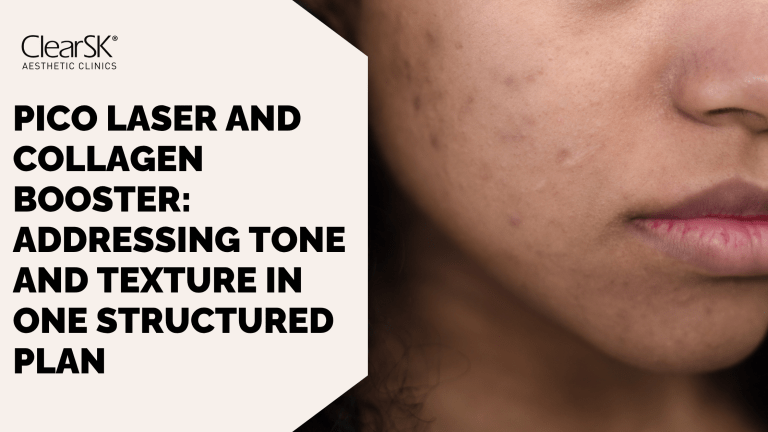
- Post-acne pigmentation marks
- General skin dullness linked to accumulated melanin
One important point: Pico Laser is designed to target the pigmentation — the colour problem. It does not directly address the skin’s surface hydration or radiance. These are different concerns that require a different approach.
What Rejuran Skin Booster Addresses
Rejuran Skin Booster (DEP) (a salmon-DNA-derived skin booster) is a Korean-developed cosmetic treatment built around PDRN (Polydeoxyribonucleotide) and amino acids, delivered topically through dermo-electroporation (DEP) — a non-injection method that uses gentle electrical pulses to help the formula penetrate the skin’s surface layers. PDRN is understood to support the skin’s own surface renewal processes and may help with hydration and radiance.
The amino acids in the formulation may help support hydration — which is particularly relevant for skin that has become dehydrated, sensitive, or fatigued over time.
Rejuran Skin Booster (DEP) is typically considered for:
- Skin that appears dull, flat, or lacking in vitality
- Dehydrated skin that doesn’t respond well to surface moisturisers alone
- Fine surface lines and uneven texture
- Skin that needs extra surface support following cumulative stress or damage
Rejuran Skin Booster (DEP) is designed to work at the skin’s surface layer. It does not address melanin, dark spots, or pigmentation directly. For patients whose main concern is visible discolouration, this skin booster alone would not be the most relevant approach.
Pico Laser vs Rejuran Skin Booster (DEP): A Quick Comparison
| Pico Laser | Rejuran Skin Booster (DEP) | |
|---|---|---|
| Downtime | Minimal, some redness may resolve quickly | Minimal to none |
| Who it suits best | Dark spots, sun damage, uneven tone | Dullness, dehydration, fine lines, loss of radiance |
| Pain level | Mild, may be eased with numbing cream | Minimal, non-injection delivery |
| Results-onset speed | Gradual, over days to weeks | Gradual, builds across a course of sessions |
| Longevity | Effects may be supported with periodic follow-up sessions | Effects may be supported with periodic follow-up sessions |
| Cost per month of result | Varies by number of sessions; a personalised quote is provided at consultation | Varies by number of sessions; a personalised quote is provided at consultation |
Disclaimer: this table is a general guide only, not a guarantee. Outcomes vary from person to person, and which treatment is appropriate depends entirely on an individual assessment by a doctor.
Why These Two Treatments Complement Each Other
The distinction comes down to what each treatment actually changes:
Pico Laser is designed to work on skin colour and tone — breaking down the pigmentation that makes the complexion look uneven and patchy.
Rejuran Skin Booster (DEP) is designed to work on skin surface quality — addressing the hydration deficit and loss of radiance that make the skin look dull and tired even after the spots are gone.
This is why the combination comes up clinically. A patient who completes laser treatment and achieves clearer pigmentation may still notice that their skin looks flat or lacks vitality — because the underlying skin quality concern was always separate from the pigmentation concern. Addressing only one dimension leaves the other untouched.
When both concerns are present — and for many adults dealing with pigmentation, they are — a doctor may assess whether a structured plan addressing both would be appropriate for that individual’s skin condition and history.
What to Expect From a Plan That Includes Both
Pico Laser sessions generally involve a short recovery period, though individual experiences vary. Rejuran Skin Booster (DEP) is applied topically via dermo-electroporation. Multiple sessions spaced a few weeks apart are standard for both treatments, with intended effects that may build progressively over time.
Your doctor determines the timing and sequencing of both treatments based on your skin condition, sensitivity, and goals.
Combined Plan: Pico Laser + Rejuran Skin Booster (DEP)
| Pico Laser + Rejuran Skin Booster (DEP) | |
|---|---|
| Downtime | Minimal; some redness from Pico may resolve quickly |
| Who it suits best | Those with both melanin-driven discolouration and concurrent surface-level dullness or dehydration |
| Pain level | Mild for Pico (may be eased with numbing cream); minimal for the skin booster |
| Results-onset speed | Pico results build over days to weeks; skin booster changes build across sessions |
| Longevity | Both may be supported with periodic follow-up sessions |
| Cost per month of result | Varies by number of sessions for each treatment; a personalised quote is provided at consultation |
Disclaimer: this table is a general guide only, not a guarantee. Outcomes vary from person to person, and which treatments are appropriate depends entirely on an individual assessment by a doctor.
How These Two Treatments Are Considered Together at ClearSK
When a clinical assessment identifies both pigmentation concerns and underlying skin quality decline, a doctor at ClearSK may structure a care plan that addresses each concern through the appropriate mechanism. Two approaches that commonly arise in this context are:
- Picosecond toning + salmon-DNA-derived skin booster (DEP): for patients presenting with both melanin-driven discolouration (dark spots, sun damage, post-acne marks) and concurrent surface-level quality decline (dehydration, loss of radiance). The laser component addresses the colour concern; the topical skin booster addresses surface renewal.
- Pico laser pigmentation protocol + surface-level renewal: for patients where the colour concern and the skin quality concern are both clinically present and assessed as independent priorities, requiring a structured plan that works on two distinct skin concerns — pigmentation and surface hydration — simultaneously.
Sequencing, session intervals, and the specific protocol depend on individual clinical assessment. Both approaches require a consultation to establish suitability.
Frequently Asked Questions
Starting With a Proper Assessment at ClearSK
If you’ve been thinking about Pico Laser, Rejuran Skin Booster, or a plan that includes both, the practical starting point is a consultation with a registered doctor who can assess your skin in person.
At ClearSK, our doctors evaluate each patient’s concerns individually before making any recommendation. The goal is a plan that is clinically appropriate for your skin — not a one-size-fits-all approach.
Why Patients Choose ClearSK
- 17+ years trusted in Singapore
- Thousands of treatments performed across our network of Singapore clinics
- 100+ treatment selections across skin, face, body and hair growth
- Doctor-designed protocols — treatment plans are developed and overseen by registered medical practitioners
- Multiple clinic locations across Singapore, with consistent clinical standards at each
Because these treatments work through different mechanisms, at different depths, for different concerns, no single recommendation applies to everyone. At ClearSK, our doctors evaluate each patient’s concerns individually before making any recommendation.
Which Is Relevant for You?
- Mainly dealing with dark spots, sun damage, or uneven tone? Pico Laser may be the more relevant starting point.
- Mainly dealing with dullness, dehydration, or loss of radiance? Rejuran Skin Booster (DEP) may be more relevant for that.
- Noticing both colour and quality concerns? A consultation can help determine whether a plan addressing both makes sense for you.
References
- Polydeoxyribonucleotide: A promising skin anti-aging agent. Chinese Journal of Plastic and Reconstructive Surgery, 2022.
- Treatment of Laser-Responsive Dermal Pigmentary Conditions in Type III–IV Asian Skin With a 755-nm Picosecond Pulse Duration Laser: A Retrospective Review of Its Efficacy and Safety. PMC.
- Comparison of the Efficacy of 1064- and 730-nm Picosecond Lasers for Acquired Dermal Melanocytosis. PMC.