Table of Contents
ToggleKorean HIFU and Wrinkle Reduction Injections: Addressing Two Different Dimensions of Facial Ageing
Quick summary: Korean HIFU and wrinkle reduction injections using botulinum toxin address two structurally distinct aspects of facial ageing — one using focused ultrasound designed to support tightening in deeper tissue layers, the other temporarily relaxing specific facial muscles to support softening of expression lines. Because sagging tissue and dynamic wrinkles are different problems with different origins, a doctor may consider both as part of the same care plan when both concerns are present.
Wrinkle reduction injections containing botulinum toxin are a prescription-only medicine in Singapore and may only be prescribed and administered by a registered medical practitioner following a clinical assessment.
Korean HIFU vs Wrinkle Reduction Injections: A Quick Comparison
| Korean HIFU | Wrinkle Reduction Injections | |
|---|---|---|
| Downtime | Minimal to none | Minimal to none |
| Who it suits best | Those with tissue laxity or structural descent (jawline, cheeks, lower face, neck) | Those with dynamic wrinkles from muscle movement (forehead, frown lines, crow’s feet) |
| Pain level | Mild discomfort, may be eased with numbing cream | Mild, brief discomfort at injection points |
| Results-onset speed | Gradual, developing over time (timelines vary) | Apparent within the first few weeks |
| Longevity | Effects may last a period of months, with maintenance considered | Effects typically last around 3–6 months, with maintenance considered |
| Cost per month of result | Varies by treatment area and session frequency; a personalised quote is provided at consultation | Varies by area treated and maintenance schedule; a personalised quote is provided at consultation |
Disclaimer: this table is a general guide only, not a guarantee. Outcomes vary by individual, and which treatment is appropriate depends entirely on an individual assessment by a doctor.
Facial Ageing Happens on Multiple Levels
When patients describe wanting to “look less tired” or “turn back the clock a little,” they’re often talking about more than one thing at once — without necessarily knowing it.
A face that has aged noticeably typically shows changes across several dimensions simultaneously: tissue that has shifted and softened over time, skin that has loosened along the jawline and cheeks, and expression lines that have deepened through years of repeated muscle movement. Each of these changes has a different origin, involves different anatomical structures, and responds to different clinical approaches.
Korean HIFU and wrinkle reduction injections address two of these dimensions specifically. Understanding the distinction is valuable for anyone who wants to make sense of what their face is actually doing — and what a doctor might recommend for each concern.
What HIFU Addresses: Tissue Laxity and Structural Descent
The deeper layers of the face contain a fibromuscular network known as the SMAS — the superficial musculoaponeurotic system. This is the structural layer that supports the overlying skin and fat, and it plays a central role in how the face holds its shape over time.
As the face ages, the SMAS and the surrounding connective tissue gradually lose tension. The skin above it begins to descend. What was once a well-defined jawline softens. The cheeks lose their lifted position. The neck develops horizontal lines and loose skin. This is tissue laxity — a structural change driven by the gradual weakening of the tissue framework beneath the skin.
Korean HIFU uses High-Intensity Focused Ultrasound to deliver targeted energy deep beneath the skin’s surface. The technology reaches tissue depths including the SMAS layer, where the controlled heat is designed to stimulate a collagen response within the tissue. This may produce a gradual tightening and lifting effect as the tissue remodels, with visible changes developing over time, though timelines vary between individuals.
Korean HIFU at ClearSK uses a pen applicator, which allows the doctor to target different tissue depths and areas, including the forehead and eye region. Treatment areas typically include the jawline, cheeks, lower face, and neck.
HIFU does not address facial expression lines caused by muscle movement. It works on tissue structure — not the muscles themselves.
What Wrinkle Reduction Injections Address: Dynamic Lines from Muscle Movement
A different category of facial lines has an entirely different origin: the repeated contraction of specific facial muscles over years and decades of expression.
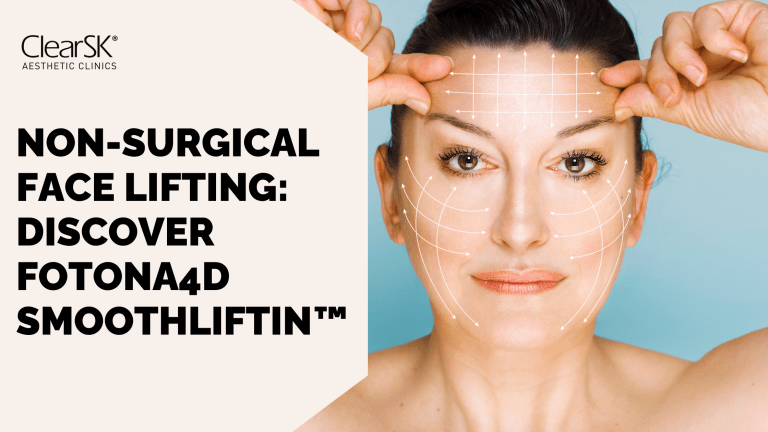
Every time a person frowns, raises their eyebrows, or squints, the muscles involved contract and the overlying skin folds in a predictable pattern. Over time, these folds become grooves — lines that are visible even when the face is at rest. These are called dynamic wrinkles, and the key anatomical driver is muscular, not structural.
Wrinkle reduction injections containing botulinum toxin — a prescription-only medicine — work by temporarily blocking the nerve signals that trigger contractions in the targeted muscles. With the muscle activity reduced, the repeated folding of the skin lessens, and existing dynamic lines become less visible. The reduced muscle activity may also lessen repeated skin folding in the treated areas during the period of effect.
Common treatment areas include the horizontal lines across the forehead, the vertical lines between the brows that form during frowning, and the fine lines at the outer corners of the eyes associated with squinting. In some cases, jaw slimming can also be addressed by relaxing the masseter muscles.
The effects of wrinkle reduction injections are temporary. The muscle activity gradually returns over time, and maintenance treatments are typically needed to sustain the result.
Because botulinum toxin is a prescription-only medicine in Singapore, it can only be legally prescribed and administered by a registered medical practitioner. A clinical assessment is required before treatment — the doctor must evaluate the patient in person to determine suitability, identify any contraindications, and decide on the appropriate approach for that individual.
Why Both Concerns Often Appear Together
Tissue laxity and dynamic wrinkles are different problems — but there is no reason a person cannot have both at once.
In practice, many patients in their 30s and 40s begin to notice both: the jawline is softening and facial definition is changing, and the frown lines or forehead lines that were once only visible during expression are now present even at rest. These are independent processes. Tissue descent does not cause dynamic wrinkles, and dynamic wrinkles do not cause tissue laxity. But they share a timeline — both tend to become more noticeable through the same decades of life.
When a doctor assesses a patient and identifies meaningful tissue laxity alongside dynamic wrinkles that are appropriate for treatment, they may consider whether a care plan addressing both structural and muscular concerns makes sense for that individual’s specific presentation.
This requires an in-person assessment. The severity of each concern, the specific areas involved, the patient’s suitability for each treatment, and the sequencing and interval between treatments all need clinical judgement.
What a Plan Including Both May Involve
Korean HIFU and wrinkle reduction injections work through different mechanisms and at different tissue levels, so they may be considered within the same care plan when clinically appropriate.
HIFU results from collagen remodelling develop gradually over the weeks following the procedure, with the tightening and lifting effect typically becoming more visible over several months. Wrinkle reduction injections take effect more quickly as the targeted muscles relax, with the softening of expression lines becoming apparent within the first few weeks.
The specific approach, timing, and intervals for both are determined by the doctor during and after the initial consultation, based on the individual’s clinical presentation, skin condition, and treatment goals.
Combined Plan: Korean HIFU + Wrinkle Reduction Injections
| Korean HIFU + Wrinkle Reduction Injections | |
|---|---|
| Downtime | Minimal to none for both |
| Who it suits best | Those with concurrent tissue laxity and dynamic expression lines (e.g. early jowling with established forehead or frown lines) |
| Pain level | Mild discomfort for HIFU, may be eased with numbing cream; mild, brief discomfort at injection points for wrinkle reduction injections |
| Results-onset speed | HIFU develops gradually over time; wrinkle reduction injections apparent within the first few weeks |
| Longevity | HIFU effects may last a period of months, with maintenance considered; wrinkle reduction injections typically last around 3–6 months |
| Cost per month of result | Varies by treatment area, session frequency, and maintenance schedule for each treatment; a personalised quote is provided at consultation |
Disclaimer: this table is a general guide only, not a guarantee. Outcomes vary by individual, and which treatments are appropriate depends entirely on an individual assessment by a doctor.
Combination Approaches: Addressing Both Dimensions Together at ClearSK
For patients presenting with both tissue laxity and dynamic expression lines, a doctor may design a care plan that addresses each concern within a single treatment sequence. Two common approaches that come up in clinical planning include:
- Korean HIFU + wrinkle reduction injections for patients with early jowling and established forehead or frown lines. The HIFU addresses structural descent at the SMAS level while the injections are designed to reduce muscle-driven line formation in the upper face — the two mechanisms complement each other without overlap or interference.
- Korean HIFU + wrinkle reduction injections for patients with neck and lower face laxity alongside crow’s feet or periorbital expression lines. Where HIFU is designed to support tightening and lifting of the lower face and neck, wrinkle reduction injections are designed to target the periorbital lines that form independently from repeated squinting — a concern that HIFU alone does not resolve.
The suitability, sequencing, and interval between any combination of treatments is determined through clinical assessment. A doctor will advise on what is appropriate for your specific presentation.
Frequently Asked Questions
Starting With the Right Assessment
If you are noticing changes in your facial contour and also expression lines that have deepened over time, a consultation with a doctor who can examine your face properly is the right starting point. What you see in the mirror often involves more than one change — and an accurate assessment is the basis for any sensible recommendation.
At ClearSK, our registered doctors take a structured approach to understanding each patient’s concerns before recommending anything. The goal is a plan that addresses what is actually present and clinically relevant for you.
Why Patients Choose ClearSK
- 17+ years trusted in Singapore
- Thousands of treatments performed across our network of Singapore clinics
- 100+ treatment selections across skin, face, body and hair growth
- Doctor-designed protocols — treatment plans are developed and overseen by medical practitioners
- Multiple clinic locations across Singapore, with consistent clinical standards at each
All treatments are performed or supervised by registered medical practitioners. ClearSK is a licensed aesthetic medical clinic in Singapore.
References
- Complications and Risks of High-Intensity Focused Ultrasound (HIFU) in Esthetic Procedures: A Review. MDPI, 2025.
- Suh DH, et al. High-Intensity Focused Ultrasound for the Treatment of Wrinkles and Skin Laxity in Seven Different Facial Areas. PMC.
- Systematic Review of High-Intensity Focused Ultrasound in Skin Tightening and Body Contouring. Aesthetic Surgery Journal, Oxford Academic, 2025.
- Botulinum toxin type A for facial wrinkles. Cochrane Database of Systematic Reviews, PMC.